"Optimizing" PTO

Ryan Gibson
Author
Ryan Gibson
Quantitative Analyst | Computer Scientist
Table of Contents

I have a particularly bad habit of waiting until the very end of the year to take time off. Looking this up online, I stumbled across a “Holiday Optimizer” that claims to “make the most of your paid time off.”

I feel this is especially important in the United States, which has the worst paid time off policies in the developed world. As a nation, we have zero guaranteed holidays, no mandated sick leave or maternity leave, and an average of ~10 days of PTO per year.1

Holiday optimizer
#

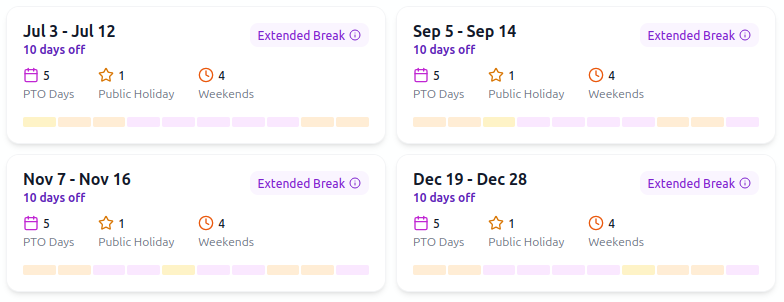
Curious, I arbitrarily ran 4 weeks of PTO, prioritizing extended vacations, and got the following suggestion.

The holiday optimizer suggests 5 days off in each of July, September, November, and December.
No vacations until July?

Needless to say, this is not a great plan for avoiding burnout. It avoids vacations until the second half of the year!

Looking closer, they’re simply maximizing the number of consecutive days off.

That’s a reasonable heuristic and it provides a neat service, but “use holidays and weekends to get longer vacations” is not particularly novel.

A toy model of burnout / stress
#

I would think that this type of optimization should at least

  • Treat longer vacations as “better” than isolated days off
  • Have stress compound over time, especially when there are no breaks

As a purely ad hoc choice, consider the following process:

$$ \text{“Stress” } S(t+1) = \left[(1+\alpha)^{w\cdot(1+\kappa \cdot r)} \cdot (1-\beta)^{(1-w)\cdot(1+\kappa \cdot r)}\right] \cdot S(t) + \gamma \cdot w $$

where \(w = \mathbf{1}_{\text{“work”}}\) is an indicator for whether day \(t\) is a work day, and \(r\) is the length of the current “run” of consecutive work/rest days, excluding today.2

All other variables are constants that reflect the nature of the work and the individual’s stress response.

In other words,

$$ \text{“Stress” } S(t+1) = \begin{cases} (1+\alpha)^{1+\kappa \cdot r} \cdot S(t) + \gamma, & \text{if working} \\ (1-\beta)^{1+\kappa \cdot r} \cdot S(t), & \text{if resting} \end{cases} $$

Simply because it made the dynamics look reasonable, I chose

  • Initial stress, \(S(0) = 40\%\)3
  • Daily multiplicative stress when working, \(\alpha = 2\%\)
  • Daily additive stress when working, \(\gamma = 1\%\)
  • Daily multiplicative recovery when resting, \(\beta = 6\%\)
  • Run-length multiplier for days of consecutive work/rest, \(\kappa = 5\%\)

Greedy optimization
#

To keep things simple, let’s greedily optimize the model to minimize average stress over the year.4

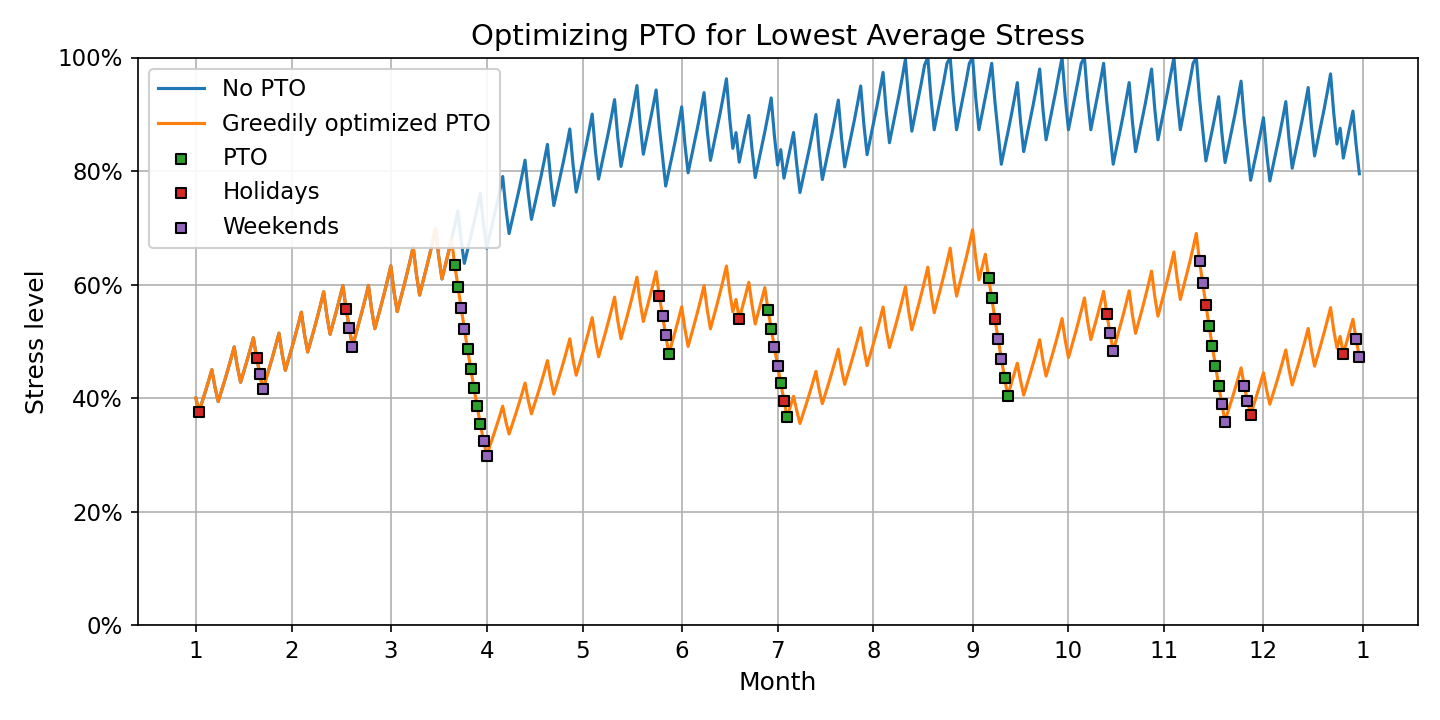
This yields the following distribution for 20 days of PTO.

A plot of stress with no PTO and PTO optimized for lowest average stress. The PTO is mainly used in four long
chunks of 7-11 days and mostly surrounding holidays. The "no PTO" stress floats around 90% for the last half of the
year while the "optimized PTO" stress oscillates around 50% all year.
Stress levels from the toy model after optimizing PTO. Note that weekends are not shown unless they are part of a longer rest period.

Notably,

  • Vacations are spread out across the year rather than clustered together
  • PTO tends to be used around holidays
  • Vacations will “extend” beyond weekends if there is a nearby holiday

This is much more in line with how most people I know actually use their PTO, aside from isolated days taken for sickness, appointments, or other obligations.

Overall themes
#

These results are not that surprising, and they match the advice you generally hear. If you have a decent bank of time off,

  • Use your PTO! Unless it would genuinely put your job at risk, don’t let your PTO expire. It’s a primary benefit of your employment.
  • Take extended breaks. Try to take a full week off5 without doing any work, if possible.6
  • Spread out your PTO. Long stretches of work with minimal breaks will eventually lead to burnout.

See also and references
#

Feel free to try out the “Holiday Optimizer” yourself, though it’s frankly best to plan out your PTO in a spreadsheet or on paper.

For more information, see the links strewn about this post and the additional sources below.


  1. Indeed, somewhere around a quarter of Americans get no PTO at all, and a meaningful fraction of those that do get PTO don’t use all of it since many jobs frown upon taking time away from work.

    In an office job, it is more typical to get most of our 11 federal holidays off (unless their state or employer overrides them), plus 2-5 weeks of PTO. If sick leave is offered, it is almost always capped and PTO is decreased to make up for it.

    Looking over at Europe, most of these benefits are legal minimums. Unsurprisingly, most Europeans take more than 20 days of PTO, which is extremely rare in the U.S.

    Survey results showing 59% of Europeans and only 13% of Americans take 21+ days of vacation lasty year. On the
        other hand, 13% of Europeans and 49% of Americans took 10 or fewer days of vacation.
    Source: Kickresume’s Europe vs. U.S. Work Survey (2024)
     ↩︎
  2. Importantly, we reset \(r=0\) when switching between work and rest. Note that any choice of compounding here introduces a slight bias towards long vacations, since the stress compounding from work is naturally limited by the length of a work week. ↩︎

  3. I’m quoting these as percentages for convenience and added a cap at \(S(t) = 100\%\), but note that the underlying process has no such constraint.

    The intent here is to demonstrate qualitative behavior, not create a perfect model. ↩︎

  4. To avoid boundary effects near the end of the year, I actually performed this optimization over two years and only show the first year. Otherwise, stress drifts slightly upward in the final month due to lack of future penalties. ↩︎

  5. If you have sufficient PTO, two-week vacations may be even better. However, a significant percentage of Americans have never taken two consecutive weeks off (depending on the industry, often between ~25-50%). ↩︎

  6. Many U.S. employers implicitly or explicitly encourage working while on PTO, but this significantly undermines the benefits. If you can, try to disconnect completely. ↩︎

Related